
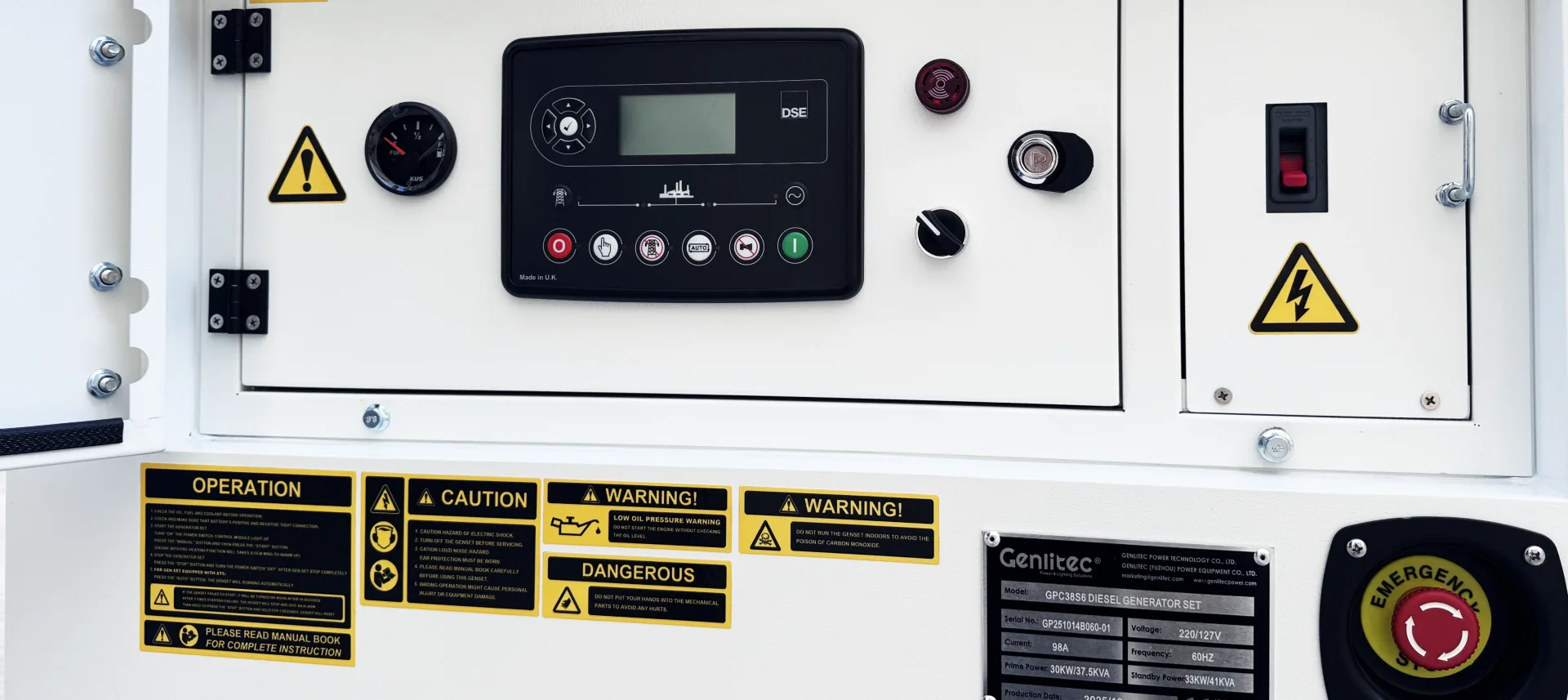
A diesel generator's frequency is directly related to engine speed. When electrical load is applied, the alternator places additional torque demand on the engine. The governor or electronic speed control system must increase fuel delivery so the engine can maintain its rated speed. If engine speed decreases, generator frequency will also decrease.
A temporary frequency dip after a sudden load application can be a normal transient response. However, if the frequency remains below the rated value, recovers too slowly, or repeatedly triggers a low-frequency alarm, the generator should be checked systematically.
Generator frequency is determined by the engine speed and the number of poles in the alternator. The basic relationship is:
For a common 4-pole alternator:
○ 50 Hz: 1500 RPM
○ 60 Hz: 1800 RPM
Therefore, when generator frequency falls significantly, the first important diagnostic question is: Does the actual engine RPM decrease when the frequency decreases?
A generator may experience a short-term frequency dip when a large electrical load is suddenly connected. The engine requires a brief period to respond to the increased torque demand created by the alternator.
The governor or electronic speed control system increases fuel delivery to restore engine speed. The magnitude and recovery time of the frequency dip depend on the engine, governor response, generator loading, load step size and generator set configuration.
If the frequency quickly returns to the rated value and remains stable, the event may simply represent the generator's normal transient response. The key distinction is whether the frequency recovers after the transient or remains below the rated value.
A frequency drop under load does not automatically mean that the generator is continuously overloaded. The starting characteristics and transient requirements of the connected loads must also be considered.
Large induction motors can draw several times their normal running current during startup. Equipment such as pumps, compressors, fans and air-conditioning systems may therefore create a substantial temporary demand even when their normal running power is within the generator's rated capacity.
The starting method also affects the transient demand. Direct-on-line (DOL) starting generally produces a higher starting current than methods such as star-delta starting, soft starters or variable frequency drives (VFDs).
The situation can become more demanding when several motors start simultaneously or when an automatic transfer system connects multiple loads to the generator at the same time.
○ Check the steady-state kW and kVA load.
○ Check the power factor and reactive load.
○ Check motor starting current and starting method.
○ Check whether several motors start at the same time.
○ Check automatic transfer and sudden load switching.
Generator selection should therefore consider both running load requirements and starting/transient requirements, not only the steady-state kW rating.
If the generator is operated above its available power capability, or if the actual operating conditions require more engine power than the generator set can deliver, the engine may not be able to maintain rated speed. In this situation, frequency can remain below the nominal value.
Operating close to the rated capacity is not necessarily a fault. However, insufficient generator capacity, excessive load, unfavorable site conditions or an unsuitable load profile can cause sustained frequency reduction.
○ Check actual generator kW and kVA.
○ Check the generator's prime or standby rating.
○ Check whether additional loads were connected after startup.
○ Check whether the generator is suitable for the required load profile.
○ Consider site conditions such as ambient temperature and altitude when evaluating available engine power.
If the engine cannot receive enough fuel when load increases, it may fail to maintain rated speed. The result can be a drop in engine RPM and generator frequency.
○ Low fuel level in the tank
○ Clogged fuel filter
○ Restricted fuel pipe
○ Fuel supply pump problems
○ Air entering the fuel system
Fuel restrictions may not be obvious at no load because the engine requires much less fuel. The problem may become apparent only when the generator is loaded and fuel demand increases significantly.
Air entering the fuel system can interrupt stable fuel delivery. The engine may run normally at light load but lose speed when additional fuel is required.
Check fuel line connections, filters, seals and the fuel supply system for possible air leakage. If the fuel system has recently been serviced or the fuel tank has been allowed to run very low, proper fuel system priming and air bleeding may also be required.
The governor or electronic speed control system is responsible for maintaining engine speed as load changes. If the system does not respond correctly, engine speed may fall excessively when the load increases.
○ Governor adjustment or calibration problems
○ Electronic actuator problems
○ Speed sensor problems
○ Wiring or connection problems
○ Incorrect speed-control configuration
Do not randomly adjust the governor or speed settings before confirming the actual cause of the frequency problem. Incorrect adjustments can create additional speed instability or operating problems.
An engine may maintain speed at no load but fail to produce sufficient mechanical power when heavily loaded. This can cause engine RPM and generator frequency to decrease.
Possible causes include poor engine condition, incorrect fuel injection, combustion problems, excessive wear or other engine performance issues. If the fuel, governor and load conditions are normal, the engine's ability to produce rated power should be evaluated according to the engine manufacturer's service procedures.
Insufficient air supply can limit combustion and engine power output. This may become more noticeable as the generator load increases because the engine requires more air to burn the additional fuel efficiently.
○ Dirty or restricted air filter
○ Restricted air intake
○ Turbocharger problems
○ Charge-air system leakage
Check the air intake, turbocharger and charge-air system according to the engine manufacturer's service requirements.
Excessive exhaust back pressure can reduce engine performance and prevent the engine from maintaining rated speed under load.
Check the exhaust pipe, muffler, silencer and other exhaust components for restrictions, especially if the exhaust system has been modified, extended or incorrectly sized after installation.
If the actual engine speed is normal but the controller reports low frequency, the problem may be related to frequency sensing, wiring, configuration or measurement. The controller display should not be treated as the only measurement source when diagnosing an abnormal frequency reading.
○ Compare the controller frequency reading with an independent frequency meter.
○ Verify voltage and frequency sensing wiring and connections.
○ Check the controller's rated frequency setting.
○ Verify that the generator is correctly configured for 50 Hz or 60 Hz operation.
If the independent meter confirms that frequency is actually low, the problem should be investigated as a generator operating condition rather than treated as a controller display problem.
| Symptom | Likely Direction |
| Frequency briefly drops and then recovers | Normal transient response or excessive load transient |
| Frequency remains low and RPM remains low | Load, fuel, governor, engine, air or exhaust system |
| Frequency remains low but RPM is normal | Frequency sensing, wiring or controller configuration |
| Low frequency together with low voltage | First verify engine speed and load; if RPM is normal, check AVR, excitation, alternator and voltage sensing |
1. Check the load: Record kW, kVA, power factor and recent load changes. Check whether large motors or multiple loads started simultaneously.
2. Check engine RPM: Determine whether actual engine speed decreases when frequency drops. This is the most important first diagnostic distinction.
3. Check the fuel system: Inspect fuel level, filters, fuel lines, supply restrictions and possible air ingress.
4. Check the governor: Inspect speed control, actuator, sensor and related wiring. Do not change governor settings without identifying the cause.
5. Check air and exhaust systems: Inspect air filters, turbocharger, charge-air system and exhaust restrictions.
6. Check engine performance: Confirm that the engine can produce its required mechanical power under the actual operating conditions.
7. Check the controller and electrical sensing: Verify frequency sensing, configuration and measurement accuracy using an independent meter when necessary.
○ Generator model and serial number
○ Engine model
○ Alternator model
○ Rated frequency and generator power
○ Frequency at no load
○ Frequency during load application
○ Frequency after stabilization
○ Actual engine RPM
○ Generator kW, kVA and power factor
○ Type of connected load
○ Motor starting information and starting method, if applicable
○ Controller alarm or fault codes
○ Photos or videos showing the frequency drop and generator operating condition
A generator low-frequency alarm should not be diagnosed simply by assuming that the generator is overloaded. The most important first step is to determine whether actual engine RPM decreases when frequency decreases.
If RPM decreases, investigate load characteristics, motor starting current, fuel supply, governor response, engine performance, air intake and exhaust conditions. If RPM remains normal while the controller reports low frequency, investigate the frequency sensing, wiring and controller configuration.
If low frequency occurs together with low voltage, first determine whether engine speed has decreased. If engine speed is normal, the investigation should also include the AVR, excitation system, alternator and voltage sensing circuit.
Following this diagnostic sequence can help identify the actual cause of a low-frequency condition without unnecessarily adjusting the governor or other generator settings.
Post time: Sep-05-2026