
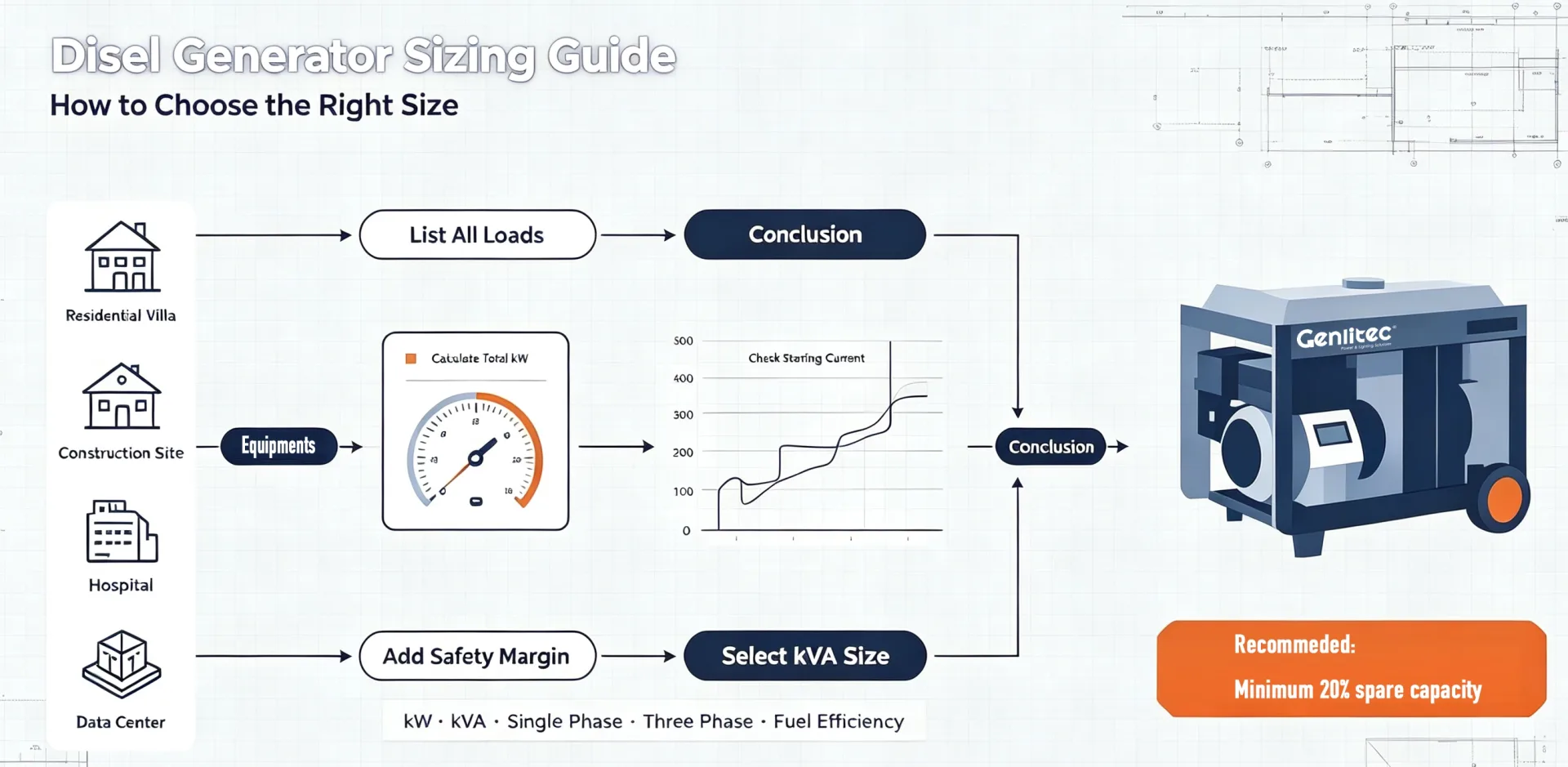
Selecting the correct diesel generator size is essential for reliable and efficient power supply. A generator that is too small may experience overload, voltage fluctuations, frequency instability, or difficulty starting large motors. On the other hand, selecting a generator that is significantly larger than necessary can increase the initial investment and may result in inefficient operation under light loads.
Diesel generator sizing should therefore be based on more than the total rated power of the connected equipment. Engineers should consider the actual running load, motor starting requirements, power factor, operating conditions, generator rating, load sequence, and potential future load growth.
This guide explains the main factors involved in diesel generator sizing and provides a practical approach to selecting the appropriate generator capacity for commercial, industrial, construction, mining, and other applications.
Why Proper Diesel Generator Sizing Matters
The generator capacity must be sufficient to supply the required electrical load while maintaining stable voltage and frequency. Incorrect sizing can create operational problems even when the generator appears to have enough rated capacity under normal running conditions.
Common problems associated with incorrect generator sizing include:
○ Generator overload during peak demand
○ Voltage drop during motor starting
○ Frequency fluctuations
○ Insufficient capacity for future loads
○ Inefficient operation at very low load
○ Increased engine and alternator stress
For this reason, generator sizing should be treated as an engineering evaluation rather than simply matching the generator's kW or kVA rating to the sum of the equipment nameplates.
Step 1: Calculate the Total Running Load
The first step in diesel generator sizing is to identify all electrical equipment that the generator will supply and determine its actual operating power.
Identify All Electrical Loads
Prepare a complete load list including motors, pumps, compressors, HVAC equipment, lighting, control systems, heaters, welding equipment, office equipment, and other electrical devices.
Determine the Actual Running Power
Equipment nameplate power does not always represent the actual operating load. Where available, measured operating data should be considered together with the equipment manufacturer's specifications.
The total running load provides the starting point for generator sizing, but it is not sufficient by itself when the system contains large motors or other loads with high starting or transient requirements.
Step 2: Add an Appropriate Capacity Margin
Once the total running load has been calculated, the generator should normally be selected with additional capacity rather than operating continuously at its exact calculated load.
For relatively straightforward applications with stable loads and no unusually large motor-starting requirements, a capacity margin of approximately 20–25% can be used as a practical preliminary sizing guideline.
Recommended Preliminary Capacity = Running Load × 1.20–1.25
For example, if the calculated running load is 300 kW, applying a 25% preliminary capacity margin gives:
300 kW × 1.25 = 375 kW
This means that a generator with approximately 375 kW of capacity may be considered as a preliminary selection for a relatively straightforward 300 kW running load. However, the 20–25% margin is not a universal requirement. The final generator size must be verified against the actual load profile, motor starting requirements, power factor, environmental conditions, operating rating, and future expansion.
Step 3: Consider Motor Starting Loads
Motor starting is one of the most important factors in diesel generator sizing. Large motors can require substantially more current during startup than during normal operation.
Typical loads that may have significant starting requirements include:
○ Water pumps
○ Air compressors
○ Fans and blowers
○ HVAC systems
○ Industrial machinery
○ Mining equipment
○ Crushers and conveyors
A generator that can supply the normal running load may still be unable to start a large motor if its transient capacity is insufficient. Excessive starting demand can cause temporary voltage and frequency dips or even generator shutdown.
Motor Starting Methods
The required generator capacity can also depend on how the motor is started. Common starting methods include direct-on-line (DOL), star-delta, soft starter, and variable frequency drive (VFD).
When a project includes large motors, the starting sequence and starting method should be reviewed before the final generator capacity is selected.
Step 4: Understand kW, kVA and Power Factor
Understanding the difference between kW and kVA is essential when selecting a diesel generator.
kW = kVA × Power Factor
For example, a 500 kVA generator operating at a power factor of 0.8 corresponds to 400 kW of active power:
500 kVA × 0.8 = 400 kW
Generator sets are commonly specified in kVA because the alternator must supply both active and reactive components of the electrical load. The actual power factor of the application should therefore be considered during generator selection.
Step 5: Select the Correct Prime or Standby Rating
Generator sizing is also closely related to the intended operating mode. A generator used as the primary power source has different requirements from a generator used only for emergency backup.
Prime Power generators are generally used for applications where the generator provides the main power source for extended or regular operation. Standby Power generators are designed primarily for emergency backup when the normal utility supply fails.
For more information, see our guide: Prime vs Standby Power Generator: How to Choose the Right Rating .
Step 6: Consider Environmental Conditions
The rated output of a diesel generator is based on specified operating conditions. Actual site conditions may affect engine performance, cooling capacity, and available generator output.
Ambient Temperature
High ambient temperatures can affect engine cooling and may require the generator system to be evaluated for the actual site temperature.
Altitude
At higher altitudes, reduced air density can affect engine combustion and cooling performance. Depending on the engine and installation conditions, derating may be required.
Dust and Harsh Environments
Mining sites, construction sites, deserts, and other harsh environments may require additional consideration for air filtration, cooling, enclosure design, and maintenance.
Step 7: Allow for Future Load Expansion
If the electrical demand is expected to increase in the future, the potential additional load should be considered during the initial generator selection.
However, there is no universal rule that a generator should always be selected with a fixed percentage of additional capacity. A 20–25% margin can be a useful preliminary guideline for relatively straightforward applications, but complex projects require a more detailed engineering assessment.
The final generator capacity should balance sufficient capacity with efficient operation while taking into account the load profile, starting requirements, environmental conditions, operating rating, and expected future expansion.
Diesel Generator Sizing Example: 300 kW Running Load
Consider a facility with the following estimated running loads:
| Load | Running Power |
|---|---|
| Lighting | 20 kW |
| HVAC | 60 kW |
| Pumps | 80 kW |
| Motors | 100 kW |
| Other Loads | 40 kW |
| Total Running Load | 300 kW |
The calculated running load is 300 kW. For a relatively straightforward application with stable loads and no unusually large motor-starting demand, a practical preliminary capacity margin of approximately 20–25% can be considered.
300 kW × 1.25 = 375 kW
Based on this preliminary calculation, a generator with approximately 375 kW of capacity may be considered as a starting point for the selection.
If the application operates at a power factor of 0.8, 375 kW corresponds to approximately 469 kVA:
375 kW ÷ 0.8 = 468.75 kVA
The final generator model should then be selected according to the manufacturer's available kW/kVA ratings and verified against motor starting requirements, load sequence, environmental conditions, and the required Prime or Standby rating.
For applications with large motors, compressors, crushers, pumps, or other high-starting-current equipment, the final generator capacity may need to be higher than the preliminary 20–25% calculation.
Common Mistakes When Selecting a Diesel Generator
1. Selecting a Generator Equal to the Total Running Load
Selecting a generator that exactly matches the calculated running load may leave insufficient capacity for load fluctuations, motor starting, transient demand, or future expansion.
2. Ignoring Motor Starting Requirements
Large motors can create substantial temporary demand during startup. This should be evaluated before the generator capacity is finalized.
3. Confusing kW and kVA
kW and kVA describe different aspects of electrical power. The relationship between them depends on the power factor of the load.
4. Ignoring Site Conditions
Altitude, ambient temperature, dust, and installation conditions can affect generator performance and should be included in the engineering assessment.
5. Choosing the Wrong Generator Rating
A generator intended for emergency standby operation should not automatically be used as the primary power source for continuous or extended operation. The generator rating must match the actual duty and application requirements.
When Should You Consult a Diesel Generator Manufacturer?
For simple applications with stable and predictable loads, basic load calculations may provide a useful starting point. However, professional generator sizing is recommended for more complex applications.
Professional evaluation is especially important for projects involving:
○ Large motors and compressors
○ Mining equipment
○ Industrial production lines
○ Non-linear loads and UPS systems
○ Parallel generator systems
○ High-altitude installations
○ High-temperature environments
○ Critical power applications
A generator manufacturer can evaluate the complete load profile and recommend an appropriate engine, alternator, generator rating, control system, and configuration for the application.
Related Diesel Generator Solutions
GENLITEC POWER provides diesel generator sets for a wide range of applications and power requirements, including commercial buildings, industrial facilities, construction sites, mining projects, oil and gas applications, and remote power systems.
Our engineering team can evaluate your load requirements and recommend a suitable generator capacity based on running load, motor starting requirements, operating conditions, power factor, and application requirements.
Need help selecting the right diesel generator?
Contact GENLITEC POWER with your required power, voltage, frequency, load information, operating hours, and application details. Our team can help you evaluate the appropriate generator size and configuration for your project.
Post time: Aug-10-2026