
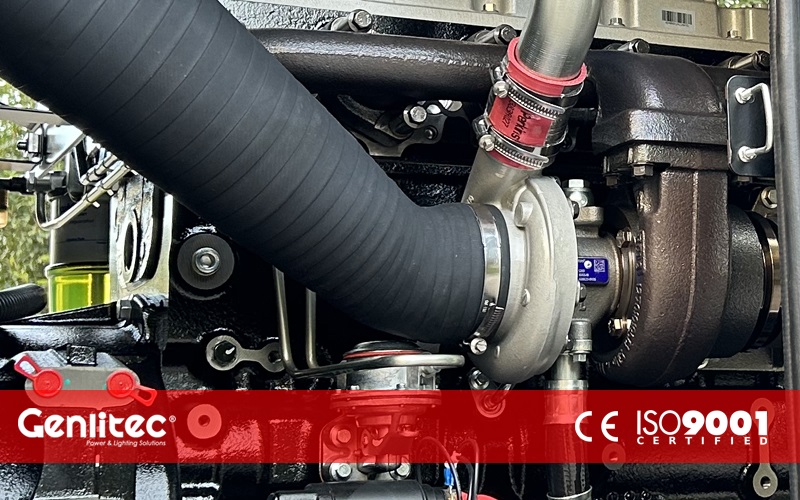
Turbocharging is an important technology used in modern diesel generator sets. It improves engine performance by increasing the amount of air entering the combustion chamber.
A turbocharger uses energy from the engine’s exhaust gases to compress the intake air. More oxygen enters the cylinders, allowing more fuel to burn efficiently and producing higher engine power without significantly increasing engine displacement.
With a greater supply of oxygen, diesel fuel can burn more completely. This improves combustion efficiency and can help reduce fuel consumption when the engine operates at the same power output.
At high altitudes, the air is thinner and contains less oxygen. Turbocharging forces more air into the engine, helping compensate for the reduction in air density and maintain better generator performance.
Better combustion can reduce incomplete combustion and help lower certain harmful exhaust emissions. Combined with modern fuel injection and emission-control technologies, turbocharged engines can achieve better environmental performance.
Turbocharging allows a relatively compact diesel engine to produce higher power. This makes turbocharged generator sets suitable for industrial, construction, mining, telecommunications, and other applications where high power output and compact design are important.
Overall, turbocharging helps diesel generator sets achieve higher power, improved fuel efficiency, better high-altitude performance, and cleaner combustion. However, turbocharged engines require proper lubrication, cooling, air filtration, and regular maintenance to ensure long-term reliable operation.
What Role Does Turbocharging Play in a Diesel Generator Set?
1. Increase Engine Power
2. Improve Fuel Efficiency
3. Improve High-Altitude Performance
4. Reduce Emissions
5. Improve Power-to-Weight Ratio
Conclusion
Post time: Sep-06-2023